
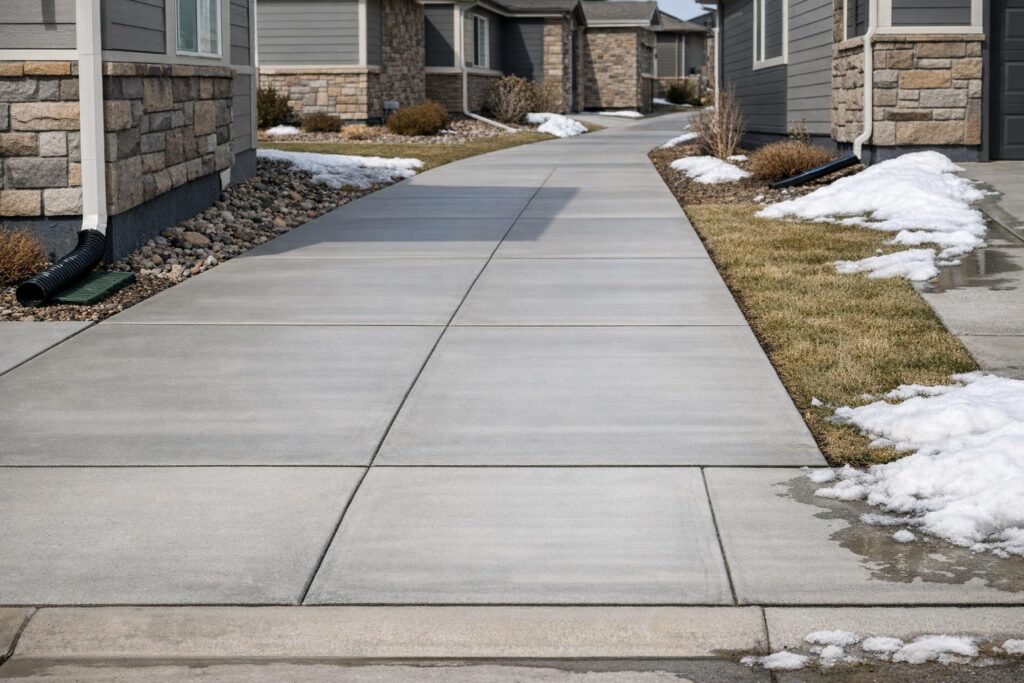
A cleaner finish outside starts with a stable slab underneath
Concrete in the Denver metro doesn’t usually fail because it’s “weak.” More often, it moves because the soil below it moves—then winter moisture and freeze–thaw cycles turn small gaps into bigger voids and noticeable drops. If you’re trying to protect curb appeal for a client (or your own home), slab leveling is one of the highest-impact fixes you can make without full replacement: less disruption, faster turnaround, and a smoother, safer surface you can design around.
Why slabs sink in Denver (and why it can look worse every year)
A sunken driveway corner or a tilted sidewalk panel usually points to one of three root issues:
• Soil loss and erosion: Water finds a path along joints, cracks, downspout discharge points, or sprinkler overspray. Over time, fines wash out and leave empty pockets under the slab.
• Consolidation/settlement: Backfilled soil along foundations, utility trenches, or newer flatwork can compress over time, especially after repeated wet/dry cycles.
• Freeze–thaw amplification: When moisture gets under concrete and freezes, it expands. Thaw cycles can leave a slightly larger void, and the slab begins to “bridge” until it cracks or drops.
For design-minded homeowners and professionals, this movement shows up as uneven reveals at garage thresholds, pooling water on patios, trip edges along walkways, and cracks that keep telegraphing through surface coatings.
Mudjacking & concrete raising: what it actually does
Concrete raising (often called mudjacking or slabjacking) lifts a settled slab by pumping material beneath it. The goal is twofold:
1) Fill voids so the slab is supported across its footprint (not just at the edges).
2) Restore elevation so transitions are safer, water drains correctly, and the surface looks “intentional” again.
This approach is especially useful when the concrete itself is structurally worth saving (no severe shattering), but the base below has changed.
Good candidates for leveling
Driveway panels, patio slabs, sidewalks/walkways, garage floors, basement slabs with localized settlement, and steps/landings where a stable lift can reduce abrupt edges.
When replacement may be smarter
Concrete that’s severely broken into multiple pieces, has major base failure across a large area, or has ongoing water problems that haven’t been corrected (downspouts, grading, persistent leaks).
If your priority is a clean, finished look (especially in highly visible front-of-home areas), it’s also worth understanding how leveling methods differ in hole size, cure time, and precision. Polyurethane lifting is often cited as using smaller injection holes and quicker cure times than traditional mudjacking, while mudjacking tends to be less expensive upfront.
Quick comparison: leveling options (what homeowners actually care about)
| Factor | Mudjacking (cement-based slurry) | Polyurethane lifting (foam) | Full replacement |
|---|---|---|---|
| Typical downtime | Often longer cure time (commonly 1–2 days) | Often usable quickly (commonly ~15 minutes) | Days to weeks (demo, base, pour, cure) |
| Injection hole visibility | Larger holes than foam | Smaller holes (often “dime-sized”) | New concrete finish (best aesthetic reset) |
| Upfront cost | Often lower than foam | Often higher than mudjacking | Highest cost, most disruption |
| Best use case | Support + lift when slab is salvageable and access is good | Precision lift in visible areas; quick return-to-service | Severely damaged slabs; major redesign of slope/drainage |
Note: Cost ranges vary widely by slab size, access, void depth, and site conditions. Many consumer resources cite mudjacking averaging lower per-square-foot than foam, with foam pricing higher but faster cure and smaller holes.
Did you know? (Trip-hazard thresholds)
For accessible routes, the 2010 ADA Standards allow vertical changes in level up to 1/4 inch. Between 1/4 inch and 1/2 inch, transitions must be beveled (not a sharp edge). Over 1/2 inch, it’s treated like a ramp condition.
Did you know? (Why the “void” matters)
Many cracks re-open because the slab is still bridging an empty pocket. Filling the void first gives the concrete a continuous base, so loads transfer into the soil more evenly.
If erosion is the main culprit, void fill services can be a key part of stabilizing the area before it gets worse.
Did you know? (Fast aesthetics wins)
Leveling can improve how a space feels immediately—straightened control joints, fewer awkward transitions at thresholds, and less water staining from chronic puddles. For client-facing exteriors, that’s a fast curb-appeal upgrade without a full demo.
A Denver-focused checklist: what to look for before you schedule leveling
If you’re evaluating a property in Denver, Aurora, Lakewood, Arvada, or the surrounding metro, a quick walk-around can tell you whether concrete leveling is likely to hold up well:
• Downspouts: Are they dumping near the slab edge? Extensions and drainage control are often as important as the lift.
• Soil contact: Is soil built up above the slab edge (trapping water) or washed away (creating voids)?
• Seasonal clues: Efflorescence, staining, or ice patches in winter can indicate water pathways under the slab.
• Joint condition: Open joints and missing sealant let water in; sealing after leveling can help reduce future washout.
• Safety transitions: Any abrupt lip near entries, walkways, or garage thresholds should be prioritized, especially if it affects accessibility.
Local keyword note
If you’re searching for concrete leveling in Aurora, CO, you’re likely seeing the same set of problems: settlement, voids from water movement, and freeze–thaw effects. The best results come from pairing the lift with basic water management so the repaired slab stays supported.
For specific areas, you can explore: driveway leveling, patio leveling, and sidewalk & walkway leveling.
Ready to level a slab without the mess of replacement?
AAA Concrete Raising has been serving the Denver metro since 1988 with minimally invasive concrete lifting, void fill, and slab stabilization. If you have a settled driveway corner, a tripping sidewalk lip, or a patio that holds water, an on-site evaluation can confirm whether leveling is the right fit.
Prefer to browse first? See additional service info here: mudjacking & concrete repair details.
Request a Concrete Leveling Quote
Mobile-friendly scheduling for Denver and surrounding communities.
FAQ: Concrete leveling & mudjacking in the Denver metro
Is concrete leveling a “temporary fix”?
It can be long-lasting when the underlying cause is addressed (voids filled and water managed). If drainage issues continue to wash out support soils, any repair method may see movement again.
How do I know if I need void fill, not just lifting?
If there’s pumping (water/soil movement at joints), hollow sounds, visible erosion channels, or repeat settlement in the same spot, void fill is often part of the right plan. Learn more here: void fill under concrete.
Will leveling fix water pooling on my patio?
Often, yes—if the slab can be lifted to restore slope away from the home. Some patios need a combination of lifting and joint sealing to keep water from re-entering beneath the slab.
What sidewalk height difference becomes an accessibility issue?
The 2010 ADA Standards address “changes in level” on accessible routes: up to 1/4 inch can be vertical; 1/4 to 1/2 inch must be beveled; beyond 1/2 inch requires a ramp approach.
Can you level a cracked garage floor?
If the slab sections are stable enough to lift together (or can be supported appropriately), leveling can improve usability and reduce uneven transitions. See options here: garage floor leveling.
Is mudjacking cheaper than polyurethane lifting?
Many homeowner pricing guides report mudjacking tends to be less expensive upfront, while polyurethane lifting is often pricier but faster to use and uses smaller injection holes.
Glossary (plain-English terms you’ll hear during an estimate)
Mudjacking / Slabjacking
A concrete lifting method where material is pumped beneath a slab to fill voids and raise it back toward level.
Void
An empty pocket beneath the concrete, often caused by erosion, soil shrinkage, or washout—one of the biggest drivers of settlement.
Trip hazard
A raised or dropped edge between slabs that can catch a foot or wheel. Accessible route guidance includes specific thresholds for changes in level.
Beveled edge
A sloped transition is used to soften small height differences so the change is not abrupt (commonly discussed for accessibility and safety).
Want examples of finished work? Visit the concrete leveling portfolio.